

Static Displays Live Events: Why They Are Failing and What’s Replacing Them
Static Displays Live Events: Why They Are Failing and What’s Replacing Them
Static displays live events used to be a reliable way to communicate brand messages, but audience behaviour has changed dramatically. Today’s visitors expect dynamic, responsive, and personalised experiences—not static posters, banners, or looping screens. As a result, static displays live events are rapidly declining in effectiveness across exhibitions, conferences, show floors, and public venues.
This article explains why these traditional tools are failing and what modern interactive technologies are replacing them.
Static Displays Fail to Capture Attention in Fast-Moving Environments
Exhibitions, conferences, and public events are high-stimulus spaces. According to research from the Event Marketing Institute, attendees now expect experiences that invite participation, not passive observation.
Static displays live events struggle because they:
- Offer no dynamic or adaptive behaviour
- Provide the same content to every viewer
- Are overshadowed by richer digital experiences
- Struggle to stop foot traffic in crowded venues
Consumers spend an average of just 1.7 seconds evaluating visual stimuli before deciding whether to engage further, as noted by eye-tracking studies from Nielsen Norman Group: If the content doesn’t move—or react—most attendees simply pass by.
Audiences Expect Personalisation, Not One-Size-Fits-All Messaging
A major shift in consumer behaviour is a preference for personalised interaction. Research from McKinsey & Company shows that 71% of consumers expect personalised experiences in all brand touchpoints:
Static displays cannot adjust based on:
- Visitor interest
- Product familiarity
- Learning style
- Technical depth required
Interactive attractions—especially hologram avatars—meet this expectation by adapting messaging dynamically based on real-time visitor input.
Static Displays Cannot Generate or Qualify Leads
Beyond awareness, modern event strategies depend on data capture, qualification, and follow-up. According to Bizzabo’s Annual Event Marketing Report, brands increasingly prioritise measurable outcomes tied to real engagement.
Static displays cannot:
- Capture attendee intent
- Guide discovery conversations
- Provide tailored information
- Register leads or questions
- Track visitor behaviour
This leaves a critical performance gap between attracting attention and converting it into value.
Static Displays Cannot Compete with Immersive Demonstrations or Human Interaction
Visitors naturally gravitate toward interactions that feel alive, responsive, or performative. Findings from Harvard Business Review show that human-like engagement dramatically increases trust and memorability in communication:
Interactive hologram avatars provide this human-like presence without requiring constant staff availability. Static displays, by contrast, merely broadcast information.
The Replacement: Truly Interactive Hologram Avatars
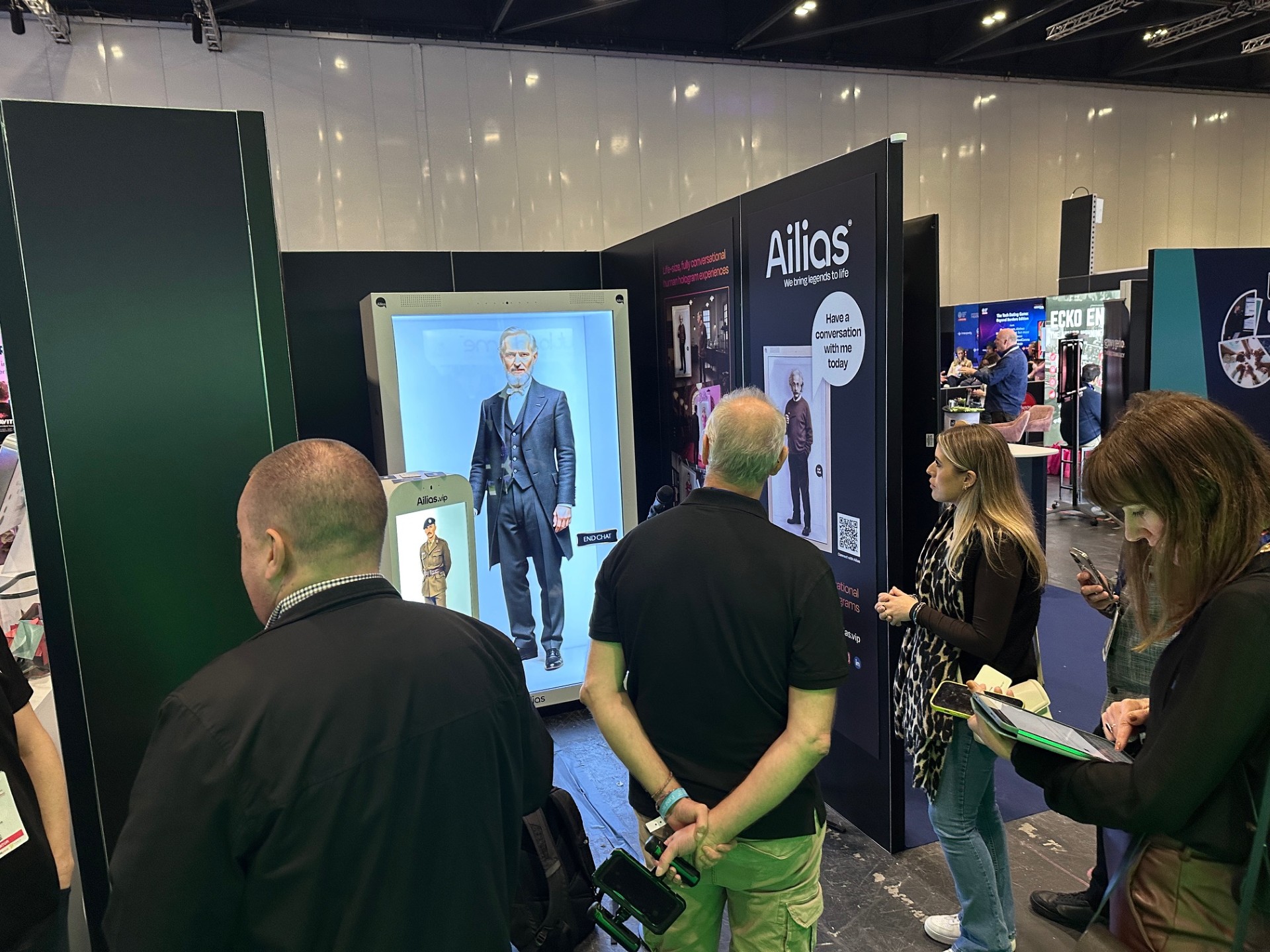
The modern solution replacing static displays is the interactive hologram avatar—a full-body digital human capable of natural conversation, product explanations, and real-time Q&A.
The shift reflects broader experiential trends outlined by MIT Technology Review, which highlights the increasing importance of “adaptive, intelligent interfaces” in public and commercial environments:
Interactive hologram avatars deliver:
- Personalised real-time answers
- Emotionally engaging presence
- Human-like gestures and expressions
- Guided conversations
- High memorability and dwell time
- 24/7 consistent brand messaging
Where older hologram technologies focus on spectacle, interactive avatars add intelligence.
This difference transforms the visitor experience from merely watching to meaningfully participating.
Platforms such as Ailias bring these capabilities to live events, enabling organisations to replace non-interactive displays with conversational digital humans capable of driving deeper engagement and measurable outcomes.
Conclusion
Static displays are no longer adequate for today’s event audiences. Visitors want experiences that move, speak, react, and personalise themselves in real time. The new standard for engagement is interactive technology—especially hologram avatars capable of natural conversation and adaptive behaviour.
By evolving from passive visuals to intelligent interaction, brands can stand out, generate stronger leads, and create moments that attendees remember long after the event ends.
Why Ailias?
Ailias isn’t just a display, it’s a platform for intelligent, emotionally driven interaction. Our full-body holograms merge high-fidelity visuals, voice synthesis, motion realism and natural conversation into one seamless experience.
We provide a complete solution; hardware, software, creative scripting and deployment so that every installation delivers performance, reliability and measurable impact.
Our clients use Ailias to:
Create holographic brand activations that attract and engage.
Deliver immersive storytelling that educates and entertains.
Provide memorable visitor experiences that boost visibility and ROI.
The Next Step in Human Connection
The rise of holographic humans signals a new era where audiences expect more than visual wow, they expect emotional authenticity and dialogue.
Ailias is leading this evolution. By combining cinematic storytelling, AI conversation, and physical presence, we’re turning holograms into something far more powerful: digital beings that connect.
If you’re exploring immersive hologram technology for your venue, event or campaign, visit Ailias.co.uk to learn more or request a personal demonstration.
We bring legends to life. At your event. On your stand. In your brand story.
Contact us today to rent or purchase an Ailias HoloMax unit for your next event.