

The UK Hologram Market in 2026: From Visual Displays to AI Digital Humans
The UK Hologram Market in 2026: From Visual Displays to AI Digital Humans
The UK hologram market is changing.
For years, the word hologram was primarily associated with visual spectacle: floating product imagery, holographic display effects, virtual appearances and installations designed to attract attention.
Those applications remain important, but a new category is emerging alongside them.
Advances in artificial intelligence, real-time rendering, speech technology and photorealistic character creation are enabling holographic displays to become interactive. Instead of simply watching a holographic image, audiences can increasingly speak to an AI-powered Digital Human, ask questions and receive relevant responses in real time.
The result is a shift from holograms as displays towards holograms as intelligent experiences.
For organisations considering the technology, understanding that distinction is becoming increasingly important.
What does the UK hologram market look like in 2026?
There is no single technology that defines the modern hologram market.
The term hologram is now commonly used to describe several different approaches, each suited to different applications.
At one end of the market are visual holographic displays, designed primarily to create impact and attract attention. These include holographic fan displays, projection-based effects and transparent display systems.
Another category focuses on remote presence, enabling a real person to appear virtually at another location for presentations, conferences and events.
A third and rapidly developing category combines physical display technology with artificial intelligence to create interactive Digital Humans.
These systems are designed not simply to be watched, but to communicate.
For a more detailed explanation of the different technologies, see our guide to hologram technology and the different types of hologram systems. The distinction between these categories is important because they solve fundamentally different communication problems.
From visual spectacle to audience interaction
Traditional holographic experiences have generally been built around a simple objective:
capture attention.
That remains valuable. A visually impressive installation can stop people in a busy exhibition hall, create a focal point in a retail environment or generate interest around a product launch.
Artificial intelligence introduces a different objective:
use that attention to create interaction.
An AI-powered Digital Human can invite someone into a conversation, answer questions, explain a product or subject, communicate in different languages and adapt its response according to what the visitor actually asks.
The experience therefore changes from:
“Look at this.”
to:
“Talk to this.”
That may prove to be one of the most important changes in the hologram market.
AI Digital Humans are creating a new category
The intelligence behind the character is becoming as important as the display in front of it.
An AI Digital Human can combine a photorealistic human appearance with conversational artificial intelligence, speech recognition, voice generation and a defined knowledge base.
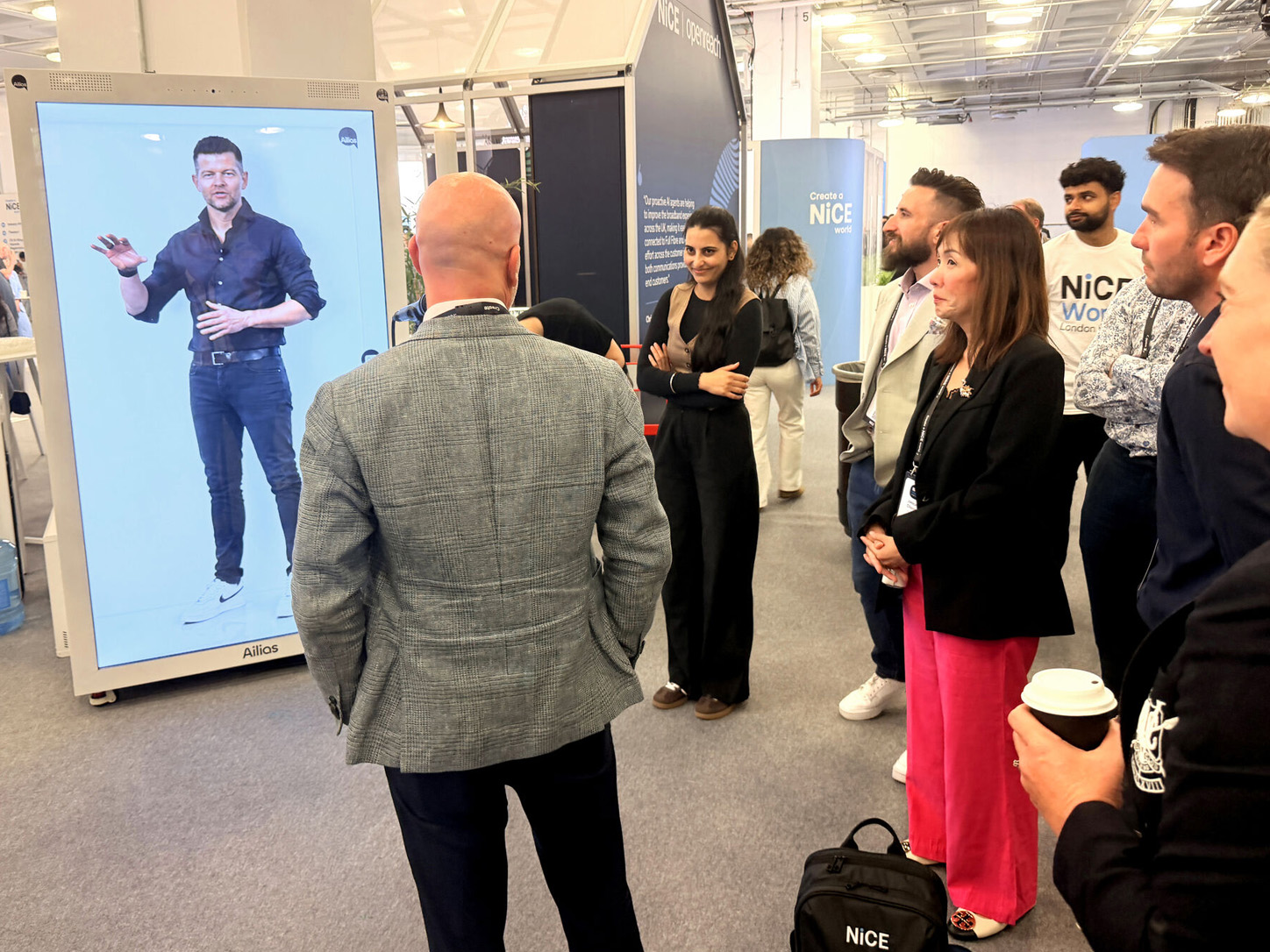
Placed within a full-height holographic display, that Digital Human becomes a physical, conversational presence within the environment.
This opens possibilities that conventional displays cannot provide.
A visitor can ask a historical character about their life.
An exhibition attendee can question a digital spokesperson about a company’s products.
A shopper can ask a brand ambassador for information.
A stadium visitor can converse with a sporting personality.
A corporate Digital Human can explain complex information drawn from an approved knowledge source.
The value increasingly comes not simply from how realistic the character looks, but from what the character can know, understand and do.
Why conversational AI is changing hologram experiences
Adding conversational intelligence fundamentally changes the relationship between an audience and a holographic character.
Instead of delivering the same presentation repeatedly, a conversational AI hologram can respond to the interests of the individual standing in front of it.
One visitor might ask a technical question. Another might want basic information. Someone else may choose to interact in another language.
The experience can respond accordingly.
This makes interactive holograms particularly relevant in environments where organisations need to communicate with large numbers of people whose interests, knowledge and questions will inevitably differ.
The technology can also create useful insight. Depending on how an experience is configured and the appropriate privacy controls, organisations can understand the questions audiences ask, subjects that generate interest and how people interact with the experience.
That begins to turn the hologram from a visual installation into a new kind of physical conversational interface.
Where interactive holograms are being used in the UK
The potential applications extend across several sectors.
Events and exhibitions
Events are a natural environment for holographic experiences because competition for attention is intense.
But attracting someone to an exhibition stand is only the first challenge. The greater opportunity is turning that attention into meaningful engagement.
Interactive holograms for events and exhibitions can act as digital spokespeople, product experts, brand representatives or extensions of a keynote experience.
Rather than repeatedly delivering a fixed presentation, they can allow visitors to explore information through conversation.
That can make the technology useful not only as a spectacle, but as part of the wider visitor journey.
Retail and brand experiences
Physical retail increasingly has to offer something that cannot simply be replicated by visiting a website.
This has created growing interest in experience-led retail: environments where technology adds interaction, entertainment, information or personalisation to the physical visit.
Interactive Digital Humans for retail and brand activations can welcome customers, explain products, represent a brand personality or become part of a larger experiential campaign.
For brands, this also creates the possibility of extending a recognisable spokesperson or ambassador into physical locations without requiring that individual to be physically present.
Museums and heritage
Museums present another particularly interesting application.
Traditional interpretation asks the visitor to read about a historical person.
Interactive technology creates the possibility of asking questions of that person.
An interactive historical Digital Human for museums and heritage attractions can help transform historical interpretation from a largely one-way presentation into a conversational experience.
This does not replace collections, curators or traditional interpretation. Instead, it provides another interface through which visitors can explore them.
The opportunity becomes particularly interesting when character creation is combined with carefully researched knowledge, historical accuracy and appropriate rights and permissions.
Business and corporate environments
The same principles apply in corporate settings.
Digital Humans can communicate complex information, support internal engagement, represent leadership, provide training or act as interfaces to organisational knowledge.
The longer-term opportunity goes considerably further.
As Digital Humans become connected to live business information and systems, the interaction can move beyond answering questions towards completing useful actions.
A customer might eventually ask a Digital Human to arrange an appointment, request a callback, check availability or initiate another business process.
The evolution is therefore from conversation towards outcomes.
Holograms and Digital Humans are not the same thing
As the market develops, terminology matters.
A holographic display is fundamentally a delivery medium.
A Digital Human is the character and intelligent interface being delivered through it.
The same Digital Human could potentially appear through a full-height holographic system, conventional screen, website or another digital interface.
Conversely, a holographic display does not have to contain an intelligent Digital Human at all. It may simply display pre-rendered visual content.
Understanding this distinction helps organisations start with the right question.
Instead of:
“Do we need a hologram?”
the more useful question may be:
“What experience do we want people to have?”
The technology can then be selected around that objective.
From novelty to measurable experience
Another important change in the UK hologram market is likely to be how success is measured.
Historically, an immersive installation might have been judged primarily by visual impact, footfall or social-media attention.
Interactive AI experiences create additional possibilities.
Organisations can potentially measure:
- number of interactions;
- duration of conversations;
- languages used;
- popular questions and topics;
- engagement with particular content;
- calls to action;
- leads or enquiries generated;
- and other experience-specific outcomes.
This makes the technology increasingly relevant to organisations looking for more than a visually impressive installation.
The question becomes not simply “Did people notice it?”, but “What happened after they did?”
The future of the UK hologram market
The next stage is likely to be defined less by advances in display hardware alone and more by the intelligence connected to the experience.
AI Digital Humans are becoming capable of accessing increasingly sophisticated knowledge sources. Integration with live data and business systems can make responses more relevant and useful.
Character creation is also improving, enabling increasingly realistic representations of brand ambassadors, executives, historical figures and other personalities.
At the same time, questions around consent, intellectual property, governance and authenticity will become increasingly important as Digital Humans become more realistic.
For organisations adopting the technology, the strongest experiences are therefore likely to combine several disciplines:
visual quality, conversational intelligence, accurate knowledge, experience design, governance and measurable purpose.
The hologram itself becomes only one component of the experience.
Choosing the right type of hologram experience
Organisations exploring the UK market should begin with the outcome rather than the hardware.
If the objective is simply to create a striking visual installation, a display-led holographic technology may be entirely appropriate.
If the objective is to enable a person to appear remotely at another location, a telepresence platform may be the better solution.
If the objective is to create conversation, storytelling, education, customer engagement or access to knowledge, an interactive AI Digital Human may be more appropriate.
These are different technologies solving different problems.
If you are specifically researching suppliers rather than the direction of the market, see our separate guide to the best hologram companies in the UK. That guide compares the different categories of provider and the types of projects for which each approach is best suited.
Where Ailias fits into this changing market
Ailias focuses on the interactive end of the market.
Our approach combines photorealistic Digital Humans, conversational AI, full-height physical presentation and experience design to create characters that audiences can engage with naturally.
The objective is not simply to create something futuristic to look at.
It is to use the initial visual impact to begin an interaction — whether that interaction involves storytelling, answering questions, communicating brand information, explaining a complex subject or guiding someone towards a useful next step.
As the market evolves, we believe this distinction between displaying information and interacting with people will become increasingly important.
The future of holographic experiences may therefore be defined less by the illusion of making a person appear in the room, and more by what becomes possible once they are there.
Frequently Asked Questions:
The market is expanding beyond display-led holographic effects towards interactive experiences that combine physical displays with AI-powered Digital Humans. This allows audiences to move from simply watching holographic content to communicating with it.
Solutions include holographic display systems, projection and transparent-display technologies, remote-presence platforms and interactive AI-powered hologram systems. Different technologies are appropriate for different objectives.
A Digital Human is the virtual character and intelligent interface. A holographic display is one method of presenting that character physically. Digital Humans can also appear on conventional screens and other digital channels.
Conversational AI enables the character to understand questions and respond dynamically rather than simply playing pre-recorded content. This allows different visitors to have different interactions with the same Digital Human.
Potential applications include events and exhibitions, retail and brand activations, museums and heritage, corporate communication, hospitality, sports and other customer-facing environments.
The market is likely to move towards more intelligent, connected and measurable experiences. Digital Humans will increasingly be able to access live information and integrate with business systems, allowing interactions to progress from answering questions towards completing useful actions.