

Beyond the Chatbot: Are AI Digital Humans Becoming a New Enterprise Interface?
Could AI Digital Humans Become the Enterprise Interface?
For decades, people have had to learn how technology expects them to communicate. We have learnt menus, commands, search terms, software workflows and increasingly complex digital interfaces.
Conversational AI begins to reverse that relationship. Instead of locating the right application or knowing how an organisation stores its information, users can increasingly explain what they need in natural language.
But conversation may only be the beginning.
Beyond words on a screen
A conventional chatbot primarily returns text. A more complete conversational interface could respond naturally while also presenting the most useful supporting information.
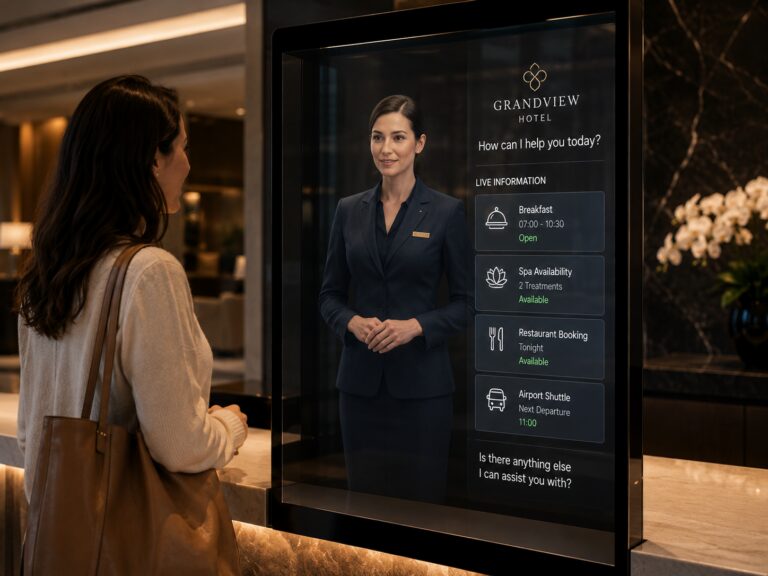
Ask about an organisation’s sustainability performance and the relevant chart could appear. Ask about a product and the interface could show it, explain its features and check current availability. At an event, a delegate could discover the next relevant session and add it to their schedule through the same conversation.
In each case, the user is no longer navigating several systems. The interface assembles the appropriate information and actions around what the person is trying to achieve.
Add a visual human presence and this starts to feel less like a chatbot and more like a human-facing interface to the organisation behind it.
From answering questions to taking action
The potential becomes more significant when conversational AI is securely connected to approved enterprise systems.
A Digital Human might retrieve live product information, consult an authorised knowledge base, present supporting media or initiate a permitted workflow. The CRM, booking platform, database and analytics system still exist, but the user may no longer need to know where each one lives or how to operate it.
This is where conversational and agentic AI begin to converge. The interaction moves beyond generating an answer towards helping someone complete an appropriate action.
That does not mean every enterprise interaction needs a human face. A search box may sometimes be faster, a dashboard clearer and a human colleague more appropriate. The value depends upon whether natural conversation and visual presence genuinely improve the experience.
The moment the technology disappears
Watching people interact with AI Digital Humans in live environments reveals an interesting pattern.
Visitors often begin by testing the system. They ask what it can do, challenge its knowledge or look for weaknesses. Once it establishes sufficient confidence, however, their attention shifts. They stop evaluating the technology and begin concentrating on what they actually want to discover.
The interface becomes less noticeable—and the purpose of the conversation becomes more important.
That may be one of the most valuable characteristics of a successful enterprise interface: people do not need to think constantly about how it works.
A human interface demands stronger governance
Giving AI a realistic face and voice also increases responsibility.
An inaccurate answer may carry more authority when it is delivered naturally by a Digital Human representing an organisation. The experience therefore needs clear decisions about:
Which information sources it may use
What subjects it can discuss
Which actions it is authorised to perform
How personal information is handled
What happens when it does not know the answer
When a conversation should be transferred to a person
If the Digital Human represents a real employee, executive or public figure, consent, likeness, voice and approved knowledge become fundamental. Audiences should also understand that they are interacting with AI.
The more human and capable the interface becomes, the higher its standard of governance should be.
A new way to access technology
AI Digital Humans will not replace every website, application or human interaction. Their more interesting role may be as one accessible way of reaching the information, media and authorised capabilities underneath an organisation.
For years, we have learnt how to use software. We are now developing software that can increasingly understand how we communicate, retrieve what we need and help us act upon it.
The real measure of the next enterprise interface will not simply be how naturally it can talk. It will be whether the conversation helps someone accomplish something valuable.
A longer version of this article by Ailias founder Adrian Broadway was originally published by The Silicon Valleys Journal.